





























Exclusive Chat: Ranbir Sidhu On His AGO Exhibition Debut, ‘No Limits’
Community Spotlight Feb 25, 2026
Based in Canada, Ranbir Sidhu is a contemporary sculptor whose practice centers on stainless steel, light, and reflection. Born in Maidenhead, England and raised in Scarborough, Ontario, Sidhu creates large-scale sculptural works that explore how form, surface, and perception shift as viewers move through space. Using advanced fabrication techniques such as welding and CNC machining, he produces seamless, mirror-finished sculptures that blur the boundary between object and environment, inviting viewers to see both the work and themselves anew.
Sidhu’s work is informed by post-war abstraction and shaped by Sikh philosophy, which enters his practice through structure, stillness, and conceptual grounding rather than overt symbolism. His sculptures are engineered with technical precision yet experienced as meditative and open-ended, placing equal emphasis on material rigor and sensory engagement.
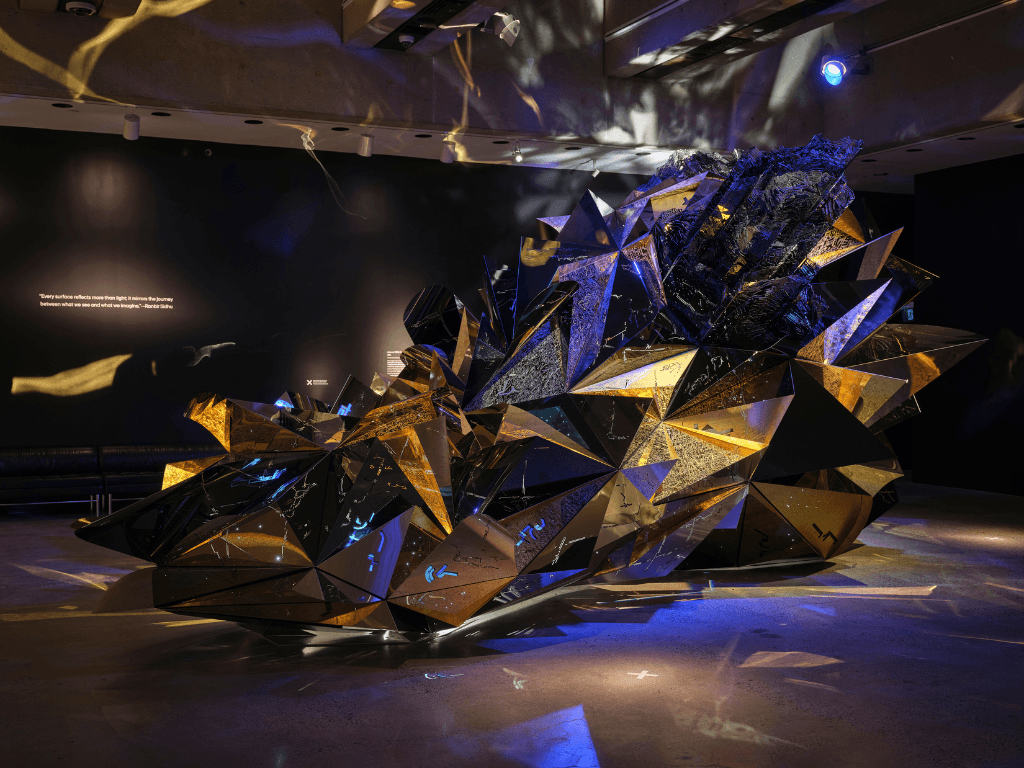
His latest exhibition, No Limits, marks Sidhu’s museum debut and is currently on view at the Art Gallery of Ontario until January 3, 2027. Tickets can be purchased here. Installed in the Signy Eaton Gallery, the exhibition features three monumental new stainless steel sculptures that transform the gallery into an immersive field of light, reflection, and movement.
In the interview below, Sidhu reflects on his artistic practice, the ideas behind No Limits, and his evolving approach to sculpture within both public and institutional spaces.
Exclusive Chat With Ranbir Sidhu
FARAH KHAN: If someone were encountering your work for the first time, how would you describe your practice today, and what continues to drive it?
RANBIR SIDHU: I make sculptures that use reflection to slow you down. The work is about space, perception, and presence, not spectacle. I’m driven by how a form can feel monumental, but still quiet. No Limits at the AGO is an invitation to look, and then look again. Perhaps they will begin to think differently about the idea of form and stainless steel as a medium.
Stainless steel is central to your sculptural language. What first drew you to this material, and how has your relationship with it deepened over time?
Stainless steel was almost a first language for me. I grew up around manufacturing environments, so the material wasn’t abstract. It was touch, weight, labour, and discipline. Later, seeing artists who embraced stainless steel helped me understand it could carry ideas, not just function. Over time, I became drawn to how it holds light and space, how it can be powerful without being loud. In No Limits at the AGO, it’s less a “material” than a way of shaping perception, so the viewer, the room, and the work fold into one experience.
Your sculptures involve advanced fabrication techniques, yet the finished works feel seamless and quietly contemplative. How do you stay closely involved in the making process and ensure your artistic intent remains present throughout?
A big part is how elements connect; I’ve had to develop joint solutions that are structurally sound but visually calm. The goal is always the same: no noise, no fuss, just presence. The technique disappears, so the feeling can stay. I’m hands-on from the first drawing to the final finish, because the meaning lives in the details. I’ve paid my dues over two decades to master the craft, with specialised training that keeps me fluent in current fabrication technologies and material science.
A lot of the work is in what you don’t see: the joints, tolerances, internal structures, and how elements connect without visual clutter. The intent is quiet clarity, so the engineering holds everything up and then steps back. In No Limits, the technique disappears so the experience can stay.
Light and reflection fundamentally shape how your sculptures are experienced. At what point did you begin designing works with perception – how viewers move, see themselves, and see the surrounding space – as a central part of the sculpture itself?
I started thinking seriously about perception when I realised that the viewer doesn’t just “look” at the work; they activate it. Artists like Anish Kapoor helped clarify that sculpture can be a condition of seeing, not only an object to be seen. Reflection, for me, is a way of making the room enter the work, and making you aware of your own presence inside it. There’s also a quiet root in my religious orientation: the idea that the self is not fixed, that perception is a practice, a way of returning to attention. In No Limits, your movement is part of the sculpture’s language.
Sikh philosophy shapes your thinking without appearing overtly on the surface of the work. How do you hold that cultural lineage within your practice while allowing the forms to speak in their own way?
Sikh philosophy sits in the work as a way of being, not as a symbol. It shapes my approach through discipline, humility, and a commitment to inner attention. I don’t feel the need to spell belief out on the surface, because the forms should have their own life. I try to keep the work open, so anyone can enter it on their own terms. For me, that openness is also a form of reverence and respect.
As a South Asian artist working within major institutions, how do you navigate visibility, expectation, and creative autonomy?
Learn to accept visibility with gratitude, but not let it script you. There’s a long, contested history here, and I’m not the first South Asian artist to enter these rooms. Senior artists like Zainub Verjee and Sarindar Dhaliwal helped make space through years of serious, sometimes difficult work, and I carry that respect with me. Expectations will always show up, but the studio has to stay truthful. No Limits is me protecting that truth, while honouring the path that made it possible.
No Limits marks your museum debut. What did this moment represent for you personally and professionally?
It’s a huge honour, especially at the AGO, with Julian Cox curating the show. Personally, it’s deeply moving because I came here as a child, walking these galleries and imagining what art could be. To return now and see my own solo exhibition in this space feels like an extraordinary kind of fulfilment. Professionally, it places the work in a serious public context, where it can be met by people without explanation. It matters, and it also feels like a beginning.
Across the three sculptures in No Limits, what ideas or questions were you most committed to exploring, and how do they surface differently in each work?
Across the three sculptures in No Limits, I was focused on how scale can feel intimate rather than overpowering. Large forms often dominate a room, but I wanted these works to hold presence without aggression, to feel monumental yet personal. That tension between size and sensitivity runs through all three.
I was also exploring how form alone can carry emotion. Each sculpture holds a different structural tension; openness, weight, balance, pause. One feels more expansive, another more grounded, another more suspended. They don’t repeat each other, but they respond to one another across the space.
Together, they create a rhythm you move through. As you walk, reflections shift, silhouettes compress and expand, and the relationships between the works keep changing. The ideas surface through that movement, not as a fixed message, but as an experience that unfolds in real time.
When audiences encounter No Limits as an installation, what kind of experience are you hoping they walk away with – emotionally, perceptually, or even physically?
I hope they feel slowed down, but not in a passive way. Slowed down in a heightened way. The world moves quickly and aggressively; No Limits is created to recalibrate that pace. When someone enters the space, I want them to become aware of their own movement, the weight of their steps, the rhythm of their breath, the subtle shift of light as they move. The installation doesn’t change dramatically; they do. And in noticing that, something begins to realign internally.
Emotionally, I’m not trying to dictate a specific feeling. It’s not about awe or spectacle, even though scale and material might initially suggest that. It’s about attunement. A quiet recalibration. If someone walks away feeling slightly more interior and a little more aware of their own presence in space, then the work has done what it needed to do. If they leave a little quieter inside, that’s enough.
Perceptually, I want the room to feel alive, almost responsive. Not because it’s interactive in a literal sense, but because reflection and geometry create a shifting field. As they move, the environment folds, multiplies, and dissolves around them. The boundaries of space feel less fixed. It becomes difficult to tell where the work ends and perception begins. That subtle destabilization is intentional. It opens a crack in certainty.
Physically, I want them to feel the piece in their body. The reflectivity and spatial layering ask them to move differently, to circle, to pause, to lean in. The installation isn’t an object to look at; it’s a field to enter. In that way, it mirrors the idea behind No Limits itself, that limitation is often a perceptual construct. When you shift your position, the frame dissolves.
Ultimately, the experience is subtle. It’s not instructive. It doesn’t tell you what to think. It creates a condition, and in that condition, something internal can expand.
For aspiring South Asian artists building long-term practices, what advice would you offer about patience, process, and claiming space within the art world?
Be patient, but be consistent. A real practice is built quietly over years, not in moments of attention. Show up for your work even when no one is watching. Learn your craft deeply as skill gives you confidence, and confidence gives you longevity.
Protect your time as there can be pressure to be practical, to explain yourself, or to fit into expectations. Don’t let that rush or dilute your voice. You don’t need to chase approval, you need to build clarity around what you’re trying to say.
Find mentors and peers who take your ambition seriously. The right community will challenge you and raise your standard. And when it comes to claiming space in the art world, you don’t ask for it, you claim it by making work that is unapologetically yours, and by sustaining it long enough for it to become undeniable.
————-
No Limits is on view at the Art Gallery of Ontario in the Signy Eaton Gallery (Level 2) until January 3, 2027. The exhibition is included with general admission. Tickets and visitor information can be found at ago.ca, where guests can book timed entry and review current hours before planning their visit.
Featured Image Credit: Installation view, Ranbir Sidhu: No Limits, December 13, 2025 – January 3, 2027, Art Gallery of Ontario. Artworks © Ranbir Sidhu. Photo AGO
Farah Khan | Editorial Director
Author
Farah Khan manages the editorial department at ANOKHI LIFE, overseeing content production, publishing, and the annual editorial calendar, while also supporting operations, projects, systems, events, and vendor coordination.
COMMENTS
YOU MAY ALSO LIKE
-

Ann Mukherjee Discusses Launch Of The First Indo-American Bengali Film 'Chheledhora', Starring Swastika Mukherjee
-
Exclusive: Sonya Singh On ‘The Fake Matchmaker’ & Writing South Asian Love Stories
-

Indo Warehouse Makes History As The Only Indian-Origin Act At EDC Mexico 2026
-
Samay Raina Brings Indian Comedy To Infosys Theater At Madison Square Garden
-
“Art From the Eye of India” Debuts At Art Basel Miami Beach With Nina Magon, Rupi Kaur & Masaba Gupta
-
Heritage Meets Growth As Tanishq Jewellery Unveils New Stores Across The U.S.
-
Exclusive: Arshad Khan On MISAFF’s Legacy & Vinod Kapri On The Soul of ‘Pyre’
-
How Surviving Stage 4 Blood Cancer Inspired Me to Create 'Chai & Hope'
-
'At The End of Kaliyuga': Toronto's Mythical Adventure For Curious Kids
-
Where Chokecherries & Bharatanatyam Collide: 'Takwahiminana' Premieres In Toronto Today
-
Why The South Asian Film Festival of Montréal Is the Cultural Event You Can’t Miss
-

“What If A Mother Divorced Her Dead Husband?” - 'The Roof Is Leaking' Play Explores Why
-
Hindu & Muslim Women Trapped By Partition: Anusree Roy's 'Trident Moon' Brings A Gripping Tale To Toronto
-
Jewelry Brand Tanishq Sparkles In The U.S. With Grand Openings In Atlanta And Seattle
-
Montreal Natyanjali: Celebrating 10 Years of Indian Classical Dance & Artistic Excellence
-

'Little Owl Stories' Celebrates South Asian Culture & Identity Through Personalized Children's Books
-
South Asian Writer/Filmmaker Forges Her Own Path In America
-
Event Alert: “Pardafash”-- A Stunning New Exhibit Is Focused On Amplifying Sikh Voices
-

EatSpreadLove Creates Dreamy Charcuterie Boards
-
Clutcheeet Elevates The Handbag Game With Personalized Designs
-
Here's Why You Can't Miss The Vancouver International South Asian Film Festival
-
Event Alert: Here's Why You Must See 'Svāhā!' by Nova Bhattacharya An "Epic Pageant Of Dance, Chant, And Ritual"
-

Care Hangers Online Thrift Store Gives Back To The Community
-
Event Alert: The Voice Gavel Club Charity Event Set To Raise Money To Support Children In Need
-

How Mubarak Cards Used Social To Become The Global Greeting Card
-
DIVERSEcity Helps Newcomers Build The Life They Want In Canada
-
Our 2021 Roundup: Tired Of Swiping? Click Matchmaking Brings A Personal Approach To Finding Your Soulmate
-
Desai Foundation Brought Back Their Iconic Diwali On The Hudson Gala
-
Here's How Plan U Will Help You Achieve Optimal Nutritional Health
-
Sign Up For BollyCORE's Movathon Fundraiser To Educate India's Underserved Children Through AIM for Seva
-

Gold Medal Powerlifter Grounded Due To COVID Gives His Time To Help Frontline Workers In Vancouver
-
SAGA Foundation Creates A Platform To Increase Awareness Of The Global South Asian Art World
-

Shayde Beauty Tackles Hyperpigmentation & Acne Scars For South Asian Skintones
-
The Beauty Market Offers Personalized Online Shopping & Virtual Beauty Consults For Those Looking To Amp Up Their Skincare
-
South Asian Sexual And Mental Health Alliance Wants To Shed Light On Taboo Topics For South Asian Youth
-

The Woodsman Beard Launches Balms & Oils For The Perfect Beard
-
Love Reconnected Aims To Teach Ways To Overcome Our Differences And Accept LGBTQ2+
-

Canadian Author Delights The Young & Young At Heart With Her Latest Book "'Twas The Night Before Diwali"
-
2RaysHope Guides NGOs In India On Ways To Build A Brighter Future For Children
-
Spirit Warrior Nation Will Enhance Your Brightest & Best Self With Online Daily Meditations & More
-
Kaur Voices Launches #MeTooSikh To Create Awareness & Support For Sikh Women
-
Joy Of Sharing Foundation Provides Free Hot Meals & Groceries For The Underserved In Southern California
-

How I Am Using My Music & Activism To Tell People To Vote
-

Desai Foundation Invites You To "Lotus Festival" — Their Uplifting Virtual Concert For COVID Relief
-
South Asians In Sports Provides A Network & Resource Space For Those Working In The Sports Industry
-
How I Have Manifested All Of My Dreams Including Writing My First Book
-
Knackstor Connects Seniors With Unique Skills With Those Looking For Contract Hires
-
How I Ignored A Publisher's Advice And Turned Into A Best-Selling Author
-
LAILY Designs Chic Custom-Made Gowns For The Woman Who Wants To Look Like A Million Bucks
-
How I Took My Mental Health Awareness And Created A Space For My Community
-
The Lotus Movement Foundation Aims To Fight The Stigma Of Mental Health In South Asian Communities
-
Ayana's Adaptive Dance With Friends Creates A Free, Safe Space For Kids With Special Needs