




















































Community Spotlight /
When Sufi Meets the Dancefloor: A Global South Asian Collaboration Reimagines “Mast Qalandar”
When Sufi Meets the Dancefloor: A Global South Asian Collaboration Reimagines “Mast Qalandar”
Community Spotlight Apr 15, 2026

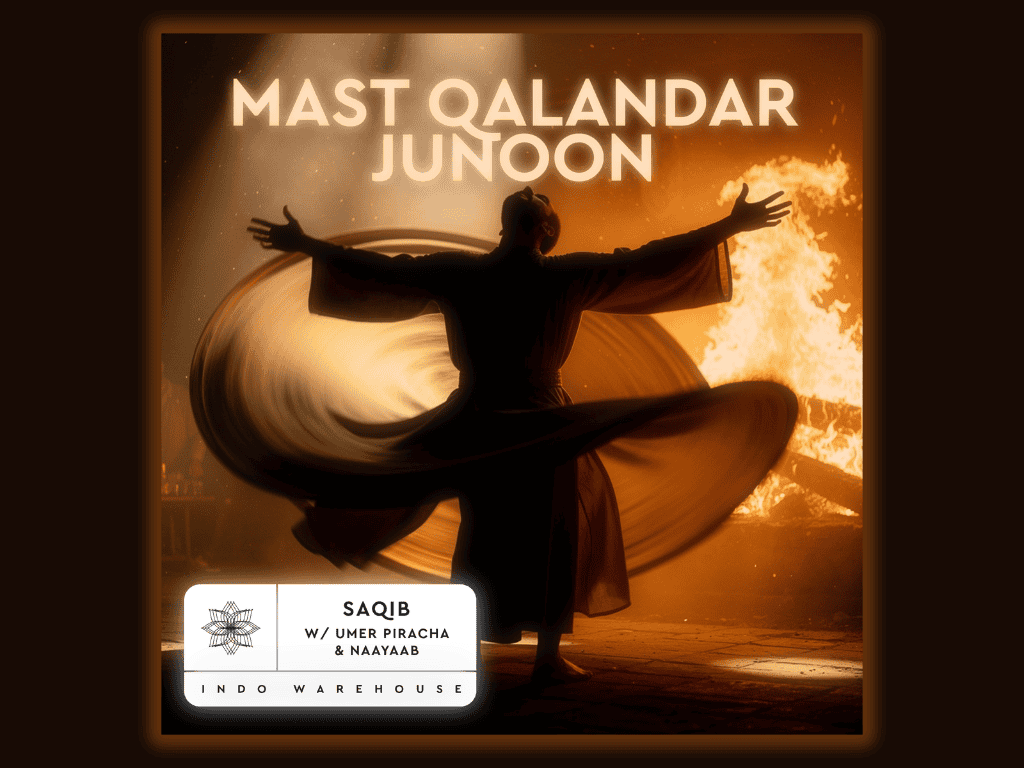
Mast Qalandar gets a modern electronic revival as artists across the South Asian music community reimagine the Sufi classic in Mast Qalandar / Junoon.
A centuries-old Sufi composition is finding new life in the electronic underground.
The newly released EP Mast Qalandar / Junoon brings together artists connected across the global South Asian music community to reinterpret one of the region’s most iconic devotional songs through a contemporary sonic lens. Released through the New York–based collective Indo Warehouse, the project merges spiritual tradition, classical influence, and modern electronic production into a sound designed for both reflection and movement.
At the centre of the collaboration is Brooklyn-based producer Saqib, who partners with Multan-born Sufi vocalist Umer Piracha and Mumbai-based artist Naayaab to reimagine the timeless resonance of Mast Qalandar. Rooted in poetry often associated with Amir Khusrow and the spiritual legacy of Lal Shahbaz Qalandar, the song has echoed for generations across dargahs, celebrations, and cultural gatherings throughout South Asia.
Rather than simply revisiting the classic, the artists reshape it into a hypnotic electronic journey—one that preserves the emotional depth of its origins while introducing new textures and rhythms suited for modern dancefloors. Anchored by Piracha’s powerful vocals and Saqib’s atmospheric production, the track bridges sacred musical heritage with contemporary club culture.
The collaboration itself came together organically. After meeting at Amsterdam Dance Event in 2024, Saqib and Piracha later reconnected in Brooklyn, discovering a shared creative language that blends traditional South Asian musical forms with electronic experimentation.
The EP’s second track, Junoon, shifts the emotional tone while continuing the project’s spirit of fusion. Drawing inspiration from Raga Bhairav, the track blends breaks, electro, and indie dance influences with Naayaab’s expressive Punjabi vocals. The result is a soundscape that captures the essence of the word “junoon” itself—passion, obsession, and the relentless drive to move forward.
The release arrives as part of the broader vision of Indo Warehouse, the New York–based electronic collective and record label founded by Kahani and Kunal Merchant. Since its launch in 2022, the platform has been redefining global dance culture by spotlighting South Asian musical heritage within contemporary electronic music—a genre they describe as “Indo House.”
With Mast Qalandar / Junoon, that vision comes full circle: a meeting point where centuries-old devotion, cultural storytelling, and modern sonic exploration converge.
ANOKHI spoke with Saqib, Umer Piracha, and Naayaab about reimagining a Sufi classic, collaborating across the global South Asian music community, and pushing the boundaries of contemporary electronic sound.
Exclusive Chat With Saqib

ANOKHI: Mast Qalandar is one of South Asia’s most iconic devotional compositions. What inspired you to reinterpret it through an electronic lens?
SAQIB: In 2018 my elder brother Ali Malik passed away. He was my biggest fan and supporter. After he passed, I started a project called Songs For Ali; remixes of his favorite songs adapted to the dancefloor in his memory. It is a way of making the world a better a place and spreading joy in his name and his memory. This project has meant everything to me over the past years and has quite a few songs in it; from Pink Floyd, Asha Bhosle, Stevie Wonder , Billie Eilish, the list goes on. Mast Qalandar was one of the first songs in that project that I wanted to work on because my brother really loved this qawali so much. But I did not want to sample from an older recording because it could never do justice to the track. So I waited to find the right vocalist. Quite a few years later I met Umer Piracha.
Your collaboration with Umer Piracha began after meeting at Amsterdam Dance Event in 2024 and later connecting in Brooklyn. What was it about hearing him perform that made you want to build a project together?
Umer has an incredible voice, range and depth. It’s hypnotic. It captivates you. When I heard him singing in Brooklyn, New York with his band Falsa, it literally brought tears to my eyes! I realized I need to get him in the studio as soon as possible.
This EP brings together artists connected to the global South Asian community and diaspora. How did that shared cultural heritage influence the creative process?
We share a common cultural lexicon that we build together from. It is rooted in tradition. We all come from it, we are aware of it, and together with that knowledge we are able to make it into something new. Without that shared background, that source code that we all operate from, we would not be able to create art like this.
Indo Warehouse has been exploring electronic music through a South Asian lens. With releases like this EP, where do you see that movement heading next?
I see it growing considerably in the coming years. It has already become its own world, its own sound. I’m really happy to see it spread and consider myself lucky to be part of it, living in this time right now and contributing to this cultural movement.
If you had to describe Mast Qalandar / Junoon in three words, what would they be?
fiery dancefloor journey
Exclusive Chat With Umer Piracha

ANOKHI: You come from a 700-year Qawwali lineage. How has that heritage shaped the way you approached performing on Mast Qalandar?
UMER PIRACHA: I’m a lifelong apprentice of the Saami Brothers of the Delhi gharana (Qawwali/Khayal), tracing back to Amir Khusrow. That training has been about refining my relationship to Sur – not just as pitch, but as a living center. Breath, body, and restraint become everything.
So with Mast Qalandar, I’m not trying to push energy out. I’m trying to get out of the way. When the body softens and the note lands, something else starts to carry it. People can feel that difference.
The track draws on poetry associated with Amir Khusrow and the legacy of Lal Shahbaz Qalandar. What does it mean to you to reinterpret such a historic composition within an electronic music context?
To me, electronic music is just the technological layer of Sufi practice. The loop, the repetition, the emphasis, the build – it’s all pointing to the same state.
So it doesn’t feel like a contrast. It feels continuous. The tools have changed, but the intention hasn’t. If anything, it’s another way of entering that space, and extending its scale, especially for people who might not walk into a dargah, but will put on headphones or step into a club.
In that sense, the club isn’t so far from the cathedral. It’s a living artwork because it “works”, not representing something else, but actually organizing people into a shared state, and illuminating a way of being together.
This project also brings together artists from different parts of the global South Asian music community. What was it like collaborating within that shared cultural tradition?
There’s a kind of immediate recognition. You don’t have to explain much. The sense of devotion, the relationship to rhythm, to repetition – it’s already there.
It felt less like building something new and more like uncovering something that was already shared. Everyone brings their own history, but the center holds. That makes the collaboration very direct, very honest.
You have performed in venues ranging from spiritual settings to stages like Carnegie Hall and Lincoln Center. Do you see projects like this EP as another way of introducing Sufi music to new audiences?
Yes. It’s another doorway. The work is the same – whether it’s a concert hall, a cathedral, or a club. This just meets people where they are. If someone comes in through this and feels even a trace of that stillness or transcendent intensity, that’s enough.
If you had to describe Mast Qalandar / Junoon in three words, what would they be?
Transcendent
Luminous
Dissolving
Exclusive Chat With Naayaab

ANOKHI: Your vocals on Junoon bring strong emotional intensity to the track. What does the word “junoon” mean to you personally?
NAAYAAB: Personally, the word ‘junoon’ means reaching a point where passion turns into something uncontrollable , almost like a kind of madness. It’s not just love for what you do, but the frustration of knowing you’re capable of more and refusing to settle for less. That feeling can really change you; you don’t remain the same person after that.
It becomes a beautiful kind of madness you either lose yourself in it or you let it push you forward. I think I chose to move forward with it. That intensity, that fire that’s what ‘junoon’ means to me, and that’s exactly what the song carries.
The song draws inspiration from Raga Bhairav while blending electronic and indie dance influences. How did you approach creating a vocal performance that fits that sonic landscape?
Since the song draws from Raga Bhairav, which has a very raw and introspective emotional quality, I wanted to bring a sense of depth and stillness into my vocal approach, while also infusing hints of funk and Punjabi folk energy. There’s a natural seriousness and weight in Bhairav, so I focused on maintaining that emotional grounding, especially through the phring and lower textures.
For me, it’s not just about the sonic aspect I’m always drawn to building a sense of a protagonist within the song. I like to pull from lived experiences and add a narrative layer, so even intense emotions feel relatable rather than heavy.
Interestingly, this wasn’t our first time engaging with that space Saqib and I had previously worked on a track titled ‘Raga’, and that process really sparked our curiosity around Bhairav. We were both intrigued by its emotional depth and wanted to explore it further.
With ‘Junoon’, the initial vocal approach was quite spontaneous as I let the emotion lead without overthinking the structure. The technical refinement came later, where we shaped it to sit within the electronic and indie dance production.
So it became a balance holding onto the soul of Bhairav while allowing the delivery to evolve within a more modern soundscape. I didn’t want it to feel overly classical or overly processed, but somewhere in between, where both worlds could coexist naturally.
This EP connects artists across the global South Asian music community and diaspora. How did that shared cultural background influence your experience working on the project?
Being part of a project that connects artists across the South Asian community and diaspora felt incredibly powerful, because there’s an unspoken cultural language we all share. It shows up naturally in the music in the way we approach melody, emotion, and storytelling without needing to be explained.
What really stands out to me is how that language and sonic space move together. The music travels far beyond where it comes from, reaching people who may not even understand the words, but still connect deeply to the feeling and the vibe. That’s something very unique to our sound it’s emotionally direct.
At the same time, every artist brings their own perspective shaped by where they are in the world, so it becomes this dynamic blend of rooted tradition and global influence. For me, it felt like being part of something that’s not just collaborative, but representative of where South Asian music is heading grounded in identity, but expanding without boundaries.
You are known for blending Punjabi lyricism with contemporary electronic sounds. How do you see South Asian voices continuing to evolve within the global electronic music scene?
I think South Asian voices in the global electronic space are evolving beyond categories. With global collaborations, we’ve started to break away from the stereotype of sticking to one kind of sound or identity, it’s more about what you bring to the table and finding like-minded collaborators.
With ‘Junoon’, writing and singing in Punjabi was instinctive rather than strategic , what I wanted to express just felt more honest in that language. As a multilingual singer, I don’t see myself limited to one language, genre, or identity. I’m constantly experimenting and breaking the orthodox structures of musical language with every track I’m part of.
For me, language, texture, and emotion are tools , not boundaries. Whether it’s Punjabi, Hindi, Arabic, or English, the intention is always to create something that feels authentic while pushing the sound forward.
Technically, it’s also about how the voice sits within the production, how it cuts through, carries emotion, and interacts with electronic elements to create impact. That’s where a lot of the evolution is happening.
We’re moving into a space where South Asian artists aren’t confined to a niche anymore , we’re shaping a fluid, global sound that’s experimental, boundaryless, and constantly evolving.
If you had to describe Mast Qalandar / Junoon in three words, what would they be?
Adrenaline, Madness, Nostalgia
Suggested Reading:
Indo Warehouse Makes History As The Only Indian-Origin Act At EDC Mexico 2026
COMMENTS
YOU MAY ALSO LIKE
-
IFFSA TORONTO 2026: Kal Penn, Sayani Gupta & A Celebration Of Dharmendra Lead The Festival Highlights
-

Malala-Backed Documentary Joins 77-Film Lineup For iSAFF 2026
-
Spotlight On Sarmad Khoosat, Hamza Haq, Nisha Pahuja & More At MISAFF 2026
-

CANADA’S CREATIVE ELITE ARE STEPPING OUT: Acclaimed Actor, Mena Massoud To Headline The Inaugural FECC Gala
-
THE ULTIMATE BOLLYWOOD SUMMER WEEKEND: Neeraj Shridhar, DDLJ & 3 Days Of Non-Stop Entertainment In Mississauga
-
Ever Been Called A "Coconut"? See How Award-Winning Canadian Play ‘bol, brown boy, bol’ Addresses This
-
FROM CANNES TO TRIBECA: Box Office Guru Media Launches New Production Arm & Expands Programming
-

A MUMBAI STORY IN TORONTO: Our Exclusive Look Inside The Play 'Elephant Song'
-
The Best Runway Moments: Inside IFE's 18th Edition Runway Showcase
-

Review: Behind the Moon — A Powerful Story of Immigrant Life Inside a Canadian Mughlai Restaurant
-

IFFLA 2026 Unveils Lineup Bringing The Best Of South Asian Cinema To Los Angeles
-

Exclusive Chat: Zaiba Baig On Her Return To Theatre With 'The Begging Brown Bitch Plays'
-

Exclusive Chat With Adi Arora: Cornell Student By Day, ‘The Voice’ Artist By Night
-
Groundbreaking Launch Of SASO Canada Aims To Elevate South Asian Voices In Film & TV
-

Ann Mukherjee Discusses Launch Of The First Indo-American Bengali Film 'Chheledhora', Starring Swastika Mukherjee
-

Exclusive: Sonya Singh On ‘The Fake Matchmaker’ & Writing South Asian Love Stories
-

Exclusive Chat: Ranbir Sidhu On His AGO Exhibition Debut, 'No Limits'
-
Indo Warehouse Makes History As The Only Indian-Origin Act At EDC Mexico 2026
-
Samay Raina Brings Indian Comedy To Infosys Theater At Madison Square Garden
-
“Art From the Eye of India” Debuts At Art Basel Miami Beach With Nina Magon, Rupi Kaur & Masaba Gupta
-

Heritage Meets Growth As Tanishq Jewellery Unveils New Stores Across The U.S.
-
Exclusive: Arshad Khan On MISAFF’s Legacy & Vinod Kapri On The Soul of ‘Pyre’
-
How Surviving Stage 4 Blood Cancer Inspired Me to Create 'Chai & Hope'
-

'At The End of Kaliyuga': Toronto's Mythical Adventure For Curious Kids
-
Where Chokecherries & Bharatanatyam Collide: 'Takwahiminana' Premieres In Toronto Today
-
Why The South Asian Film Festival of Montréal Is the Cultural Event You Can’t Miss
-
“What If A Mother Divorced Her Dead Husband?” - 'The Roof Is Leaking' Play Explores Why
-
Hindu & Muslim Women Trapped By Partition: Anusree Roy's 'Trident Moon' Brings A Gripping Tale To Toronto
-
Jewelry Brand Tanishq Sparkles In The U.S. With Grand Openings In Atlanta And Seattle
-
Montreal Natyanjali: Celebrating 10 Years of Indian Classical Dance & Artistic Excellence
-
'Little Owl Stories' Celebrates South Asian Culture & Identity Through Personalized Children's Books
-
South Asian Writer/Filmmaker Forges Her Own Path In America
-
Event Alert: “Pardafash”-- A Stunning New Exhibit Is Focused On Amplifying Sikh Voices
-

EatSpreadLove Creates Dreamy Charcuterie Boards
-

Clutcheeet Elevates The Handbag Game With Personalized Designs
-
Here's Why You Can't Miss The Vancouver International South Asian Film Festival
-
Event Alert: Here's Why You Must See 'Svāhā!' by Nova Bhattacharya An "Epic Pageant Of Dance, Chant, And Ritual"
-

Care Hangers Online Thrift Store Gives Back To The Community
-
Event Alert: The Voice Gavel Club Charity Event Set To Raise Money To Support Children In Need
-
How Mubarak Cards Used Social To Become The Global Greeting Card
-

DIVERSEcity Helps Newcomers Build The Life They Want In Canada
-

Our 2021 Roundup: Tired Of Swiping? Click Matchmaking Brings A Personal Approach To Finding Your Soulmate
-
Desai Foundation Brought Back Their Iconic Diwali On The Hudson Gala
-
Here's How Plan U Will Help You Achieve Optimal Nutritional Health
-
Sign Up For BollyCORE's Movathon Fundraiser To Educate India's Underserved Children Through AIM for Seva
-

Gold Medal Powerlifter Grounded Due To COVID Gives His Time To Help Frontline Workers In Vancouver
-
SAGA Foundation Creates A Platform To Increase Awareness Of The Global South Asian Art World
-

Shayde Beauty Tackles Hyperpigmentation & Acne Scars For South Asian Skintones
-

The Beauty Market Offers Personalized Online Shopping & Virtual Beauty Consults For Those Looking To Amp Up Their Skincare
-
South Asian Sexual And Mental Health Alliance Wants To Shed Light On Taboo Topics For South Asian Youth
-

The Woodsman Beard Launches Balms & Oils For The Perfect Beard
-
Love Reconnected Aims To Teach Ways To Overcome Our Differences And Accept LGBTQ2+
-

Canadian Author Delights The Young & Young At Heart With Her Latest Book "'Twas The Night Before Diwali"
-
2RaysHope Guides NGOs In India On Ways To Build A Brighter Future For Children
-
Spirit Warrior Nation Will Enhance Your Brightest & Best Self With Online Daily Meditations & More
-
Kaur Voices Launches #MeTooSikh To Create Awareness & Support For Sikh Women
-
Joy Of Sharing Foundation Provides Free Hot Meals & Groceries For The Underserved In Southern California
-

How I Am Using My Music & Activism To Tell People To Vote
-
Desai Foundation Invites You To "Lotus Festival" — Their Uplifting Virtual Concert For COVID Relief
-
South Asians In Sports Provides A Network & Resource Space For Those Working In The Sports Industry