






















































Culture /
Black History Month: The Story Of How Black & South Asian Cultures Intertwine
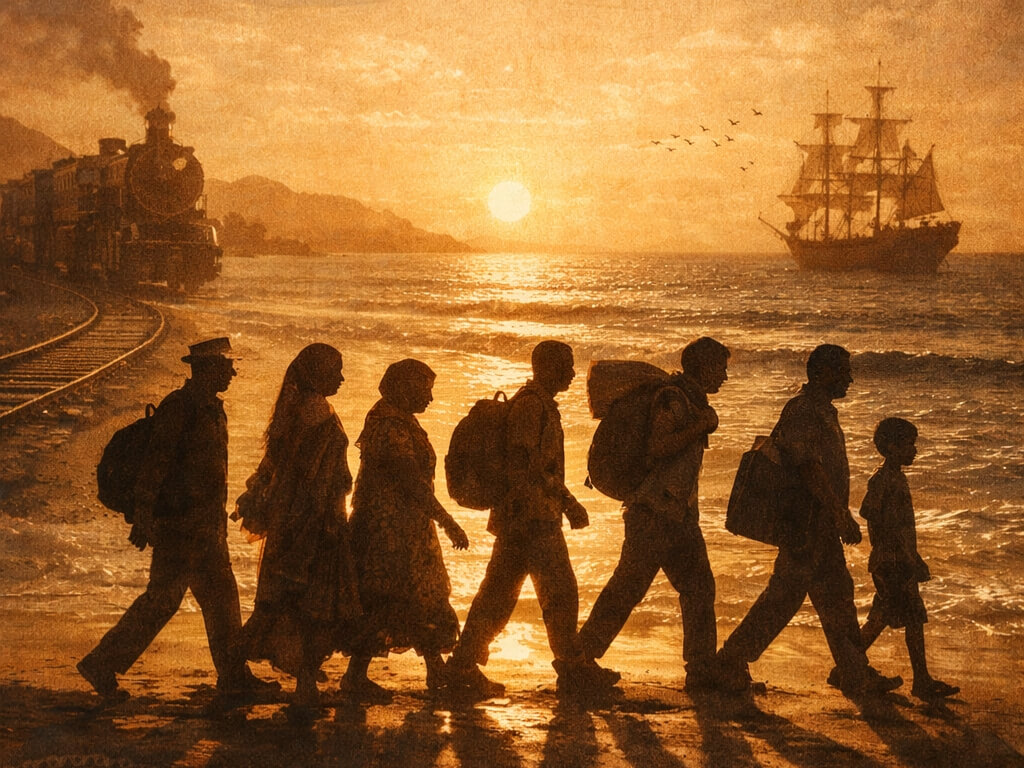
Black History Month often centres stories of resilience, resistance, and cultural legacy across the global Black diaspora. These narratives are essential. But within them exists another history, one that is frequently overlooked, quietly threaded through the same colonial systems, shared landscapes, and liberation struggles.
It is the story of South Asian communities in Black diasporic spaces, particularly across the Caribbean and parts of Africa. Their histories are not adjacent to Black history. They are deeply entangled with it.
To understand the Black diaspora fully, we must also understand how empire shaped multiple displaced communities at once, and how those communities learned to survive, adapt, and resist side by side.
Indenture & The Afterlife Of Empire

After the abolition of slavery, colonial powers did not dismantle their economic machinery. They reconfigured it.
Beginning in the mid-19th century, South Asians were transported under systems of indentured labour to work on plantations across the Caribbean, including Trinidad and Tobago, Guyana, Jamaica, and Suriname. These labourers arrived on the same lands once worked by enslaved Africans, inheriting a world already scarred by violence, extraction, and racial hierarchy.
Indentureship was not slavery, but it was far from freedom. Contracts were deceptive, conditions were harsh, and cultural erasure was common. Black and South Asian communities entered this space differently, but they lived within the same colonial framework, one designed to divide, rank, and exploit.
Empire relied on separation. Survival, however, often required proximity.
Culture Born From Forced Co-existence

Living alongside one another, Black and South Asian communities inevitably shaped each other’s worlds. Over time, food, language, music, and ritual blended into something distinctively Caribbean.
Indo-Caribbean culture emerged not as a diluted version of South Asia, but as an amalgamated identity formed within Black diasporic space. Hindu and Muslim traditions existed alongside Carnival rhythms. Indian folk melodies fused with African-derived sounds, giving rise to forms like chutney soca. Cuisine carried masala and pepper together, reflecting shared histories rather than singular origins.
This hybridity complicates tidy categories of race and culture. Indo-Caribbean people are often asked to choose between identities that history never separated. Their existence challenges the idea that diaspora can be understood through one lens alone.
Resistance Was Never Singular

Colonial systems did not only exploit labour, they manipulated difference. Yet resistance frequently crossed the very lines empire tried to enforce.
Across the Caribbean, labour movements and independence struggles saw Black and Indo-Caribbean leaders working toward shared goals of political autonomy and economic justice. In Guyana, Cheddi Jagan, an Indo-Guyanese leader, played a central role in anti-colonial politics alongside Black Caribbean figures.
These alliances were not without tension. Colonial “divide and rule” strategies created fractures that still echo today. But recognizing how those divisions were manufactured allows us to see moments of solidarity not as anomalies, but as deliberate acts of resistance against a system designed to keep communities apart.
The African Chapter We Rarely Acknowledge

A parallel story unfolded across parts of Africa.
South Asians were brought as indentured labourers to build railways and work plantations in countries such as Kenya, Uganda, and South Africa. Others arrived later as traders, occupying precarious positions within colonial racial hierarchies.
It was in South Africa that Mahatma Gandhi first developed his philosophy of nonviolent resistance while challenging discriminatory laws targeting Indians. His activism unfolded alongside broader Black resistance movements fighting white supremacy and segregation.
Post-independence, these dynamics became even more complex. The cultural, economic, and political imprints of South Asian communities across Africa remain deeply embedded.
Migration And The Problem Of Invisibility

When Indo-Caribbean communities migrated to North America, complexity did not disappear. It intensified.
In cities like Toronto and New York, Indo-Caribbean Canadians built vibrant communities shaped by South Asian ancestry and Caribbean history. Yet their stories remain largely absent from mainstream media and cultural narratives.
They are often erased within Black discourse and overlooked within South Asian spaces, despite belonging to both. This invisibility has real consequences, particularly in creative industries.
Artists such as Richard Young, Andrea Drepaul, Darryl Hinds, and Shaun Omaid speak to the exhaustion of having to explain their identity repeatedly, or to “prove” their belonging in spaces that prefer easily legible narratives in this article . . .
Representation, in this context, is not about visibility alone. It is about recognition. About being seen without qualification.
Why This Story Belongs in Black History Month

Black History Month is not only about celebrating Black excellence, it is about interrogating the global systems that shaped Black diasporic life. The same colonial machinery that produced slavery also produced indenture. The same racial capitalism that de-humanized Black bodies relied on layered hierarchies to function.
Recognizing South Asian presence within Black diasporic history does not dilute Black narratives. It deepens them. It reveals how liberation struggles were interconnected, even when solidarity was imperfect or strained.
Toward Fuller, More Honest Histories

To centre Indo-Caribbean and Indo-African stories is not to carve out a separate lane. It is to acknowledge that diasporic histories were intertwined by design.
The pepperpot shared on Christmas Day in an Indo-Caribbean group chat.
The rhythms of chutney soca drifting through Carnival crowds.
The frustration of never seeing your family reflected on screen.
These are not footnotes. They are living archives.
Black history is global. South Asian diasporic history is global. And where they meet, we find stories of survival, synthesis, and a shared demand to be seen fully.
This Black History Month, widening the lens does not take anything away. It gives us a truer, richer understanding of how liberation has always been collective, even when history tried to convince us otherwise.

Kiran R. Khan | Culture & Lifestyle Editor
Author
Kiran R. Khan (@kiranrkhanandco) is a journalism graduate from Sheridan College, possesses an extensive freelance portfolio encompassing various topics, including lifestyle posts and profile stories. Kiran loves to craft engaging content that resonates with readers, aiming to leave a lasting impress...
COMMENTS
YOU MAY ALSO LIKE
-

TORONTO, ART, MUSIC & THE WATERFRONT COLLIDE: The Power Plant Contemporary Art Gallery Brings Back Its Signature Fundraising Party
-
FROM CHAI TO COMMUNITY: How Chaiiwala Of London Is Brewing A Cultural Movement Across Canada
-
"We’re Buying the Buildings Now": Inside ANOKHI LIFE’s Legacy Builders Event For South Asian Heritage Month
-

From Bollywood Romance To Nano Dating: How Love Has Evolved
-

How Raoul Juneja Is Building The Infrastructure Of South Asian Music In North America
-

How You Can Use The Revival Of South Asian Embroidery To Elevate Your Home
-

MISAFF 2025: Nov 24–30 Festival Features 94 Films & First Industry Symposium
-
The Lit Gala 2025: When Toronto’s Diwali Spirit Turned Into $130K For Change
-
Reel Asian 2025 Brings ‘K-Pop Demon Hunters’ Sing-Along To Toronto
-
More Than A Gala: How Diwali On The Hudson Sparks Real Change
-

Inside 'A Riddle of Thorns': The Nanua Sisters’ Spellbinding New Fantasy
-
Diwali Dance Fest Lights Up Walt Disney World® Resort’s Magic Kingdom® Park
-
Pottery DIY With Kids: Craft An Easy South Asian–Inspired Clay Dish
-

Curtains Up! The Reelworld Film Festival 2025 Kicks Off Today In Toronto
-
Celebrate & Give Back: Diwali On The Hudson 2025 Lights Up NYC Tomorrow
-
International Day Of The Girl Child: How Mentorship Empowers Girls
-
New Female-Led Studio ‘Goddess On The Grind’ Sets Bold Vision
-
iSAFF 2025 Recap: Award Winners, Festival Highlights & More
-
Celebrating Trailblazers: Inside The 2025 Women Empowerment Awards
-
IFFSA Toronto 2025 Brings 100+ Film Premieres To The GTA
-

iSAFF Turns 15: A Legacy Of Bold South Asian Cinema
-

Women Empowerment Awards: A Sold-Out Celebration of Purpose, Power & Progress
-
Breaking The Cycle: Unlearning Burnout In South Asian Culture
-
Move Over, Boss Babe - The Aunty-Preneur Has Arrived!
-
Celebrating 5000 Years Of Indian Culture Inside The NMACC India Weekend This September In NYC
-
Aima Baig, Apache Indian & JoSH Headline Mosaic Festival's 20th Anniversary & You're Invited!
-
You Know You Grew Up South Asian If You’ve Heard These 10 Things
-
A Night At The Museum: Eid At The Smithsonian
-

Star-Studded Biblio Bash Gala Raises Over $1 Million For Teen Mental Health In Toronto
-
How the South Asian Relationship Summit is Bringing Culturally Relevant Insights to Modern Love
-
Why Indo-Caribbean Canadian Voices & Narratives Need Better Representation In Media
-
How Cultures Link is Empowering Immigrant Identity Through its Online Workshops & Programs
-
South Asian House Makes A Splash at Art Basel Miami for Its Second Edition
-

Roshni Media’s Much-Anticipated TIA Awards Gala Gets Ready To Take Over NYC!
-
Diwali Dance Fest Takes the Stage at Walt Disney World® Resort for a Second Year!
-
7 Characters In Desi Folklore That Put Halloween Spooks To Shame
-
Celebrities, Creators & Supporters Celebrate Diwali At Desai Foundation’s 11th Annual 'Diwali On The Hudson'
-
University Health Network (UHN)’s 'Diwali – A Night To Shine' Raises Record Breaking $2m+ To Support Health Care, Research And Innovation
-
The Lit Gala Returns To Toronto For A Night of Celebration & Charity Supporting Children With Disabilities In India
-

What Future Changemakers Can Learn From The Inspiring Canadian Women Honoured At The Women Empowerment Awards 2024
-
How 'Little Canada' Helps South Asian Newcomers Feel Welcomed & Connected
-
The Heartbreaking Failure Of The System: Dr. Moumita Debnath & The Unheard Cries Of Rape Victims
-
2024 India & Pakistan Independence Day Celebrations in North America
-
The Sold Out 2024 Women Empowerment Awards Will Present Two $10K Grants & Scholarships To Winners
-
Kavita Krishnamurti, Yasser Desai, Dr. L Subramaniam & 100+ Homegrown Stars To Perform At #BollywoodMonsterMashup
-
Why You Should Celebrate Summer in Style with Rosé - Toronto's Premium Picnic Experience
-
South Asian Heritage Month: Spotlighting South Asian NGOs Fighting Child Hunger & Poverty, Homelessness, Domestic Violence & More
-
The Princess Margaret Cancer Foundation Announces North America’s First and Largest Street Cricket Fundraiser: Cricket to Conquer Cancer
-
Time Magazine Honours 10 South Asians On Their Time100 List Of 2024
-
Celebrating International Women's Month: A South Asian Perspective
-
These Desi Spices Will Put You In The Mood For Valentine's Day
-
Is Prime Minister Sheikh Hasina A Problem For Bangladesh?
-
How Dr. Danister Perera Is Unlocking Sri Lanka's Indigenous Medical Secrets In Palm Leaves
-
The Inaugural Lit Gala Celebrated Diwali Raising Funds For Girls Education In Rural India
-

How The Modern South Asian Metrosexual Is Breaking Stereotypes
-
Rupi Kaur Refuses Biden's Diwali Invitation Due To The Administration's Support Of Israel's Actions In Gaza
-
Celebrities, Founders, Media & Notable South Asian Personalities Celebrate Neerja Public Relation’s 15th Anniversary
-

Why Nurturing International Students Is Key To Canada's Growth
-
India Vs Canada: Is This The Start Of A New Cold War?
-

Event Alert: The Women Empowerment Awards Honours Change-Making Women In Exclusive Gala