





























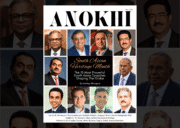












Cover Story: South Asian Heritage Month: The 10 Most Powerful South Asian Dynasties Shaping the Globe
Cover Stories May 04, 2026
For this South Asian Heritage Month, we are not simply chronicling wealth: we are documenting the rise of a new global hegemony. The axis of economic power has shifted, and at its center stand the great South Asian dynasties, the architects of a century defined by Indian enterprise. These families have transcended their origins to become the invisible scaffolding of the modern world. From the steel that frames the skylines of London and New York to the digital code that powers the Silicon Valley ecosystem, and the energy grids lighting up emerging continents, South Asian hands are at the helm.
They are no longer just building India: they are building the planet, reshaping global trade routes, and rewriting the rules of multi-generational legacy. These dynasties represent a sophisticated blend of traditional values and aggressive, forward-leaning expansionism that proves South Asian leadership is the primary engine of the 21st-century global economy.
This is a countdown of the ten most influential power centers in the world today, where heritage meets high-stakes global dominance.
10. The Mahindra Family
Active Leadership: Anand Mahindra (Chairman); Anish Shah (Group CEO – Professional Management); Mahindra family members (Active in philanthropic and educational trusts).
Major Brands: Scorpio, XUV700, Thar, Tech Mahindra, Mahindra Holidays
Geographic Reach: Presence in over 100 countries; world’s largest tractor maker
Led by Anand Mahindra, this dynasty has redefined the South Asian multinational.
The Mahindra Group operates across automotive manufacturing, farm equipment, IT consulting, financial services, hospitality, renewable energy, and aerospace engineering. Its vehicle brands—including Scorpio, Thar, and XUV—are among the most recognizable SUVs in emerging markets, while Tech Mahindra is a major global technology consulting firm.
While the group is professionally managed, Anand Mahindra remains the global face and moral compass of the ₹1.4 lakh crore empire, using his influence to pivot the group toward EVs and sustainable agriculture.
“I think the world is finally realizing that you cannot have a global strategy without a South Asian core. We are no longer the ‘back office’; we are the head office.” — Anand Mahindra
Their power is built on purpose-led globalization, moving from rural Indian heartlands to the cutting edge of EV technology and global IT consulting. They are the only dynasty to dominate both the most traditional sector (agriculture) and the most futuristic (IT) simultaneously.
9. The Jindal Family
Active Leadership: Sajjan Jindal (Chairman, JSW Group); Naveen Jindal (Chairman, Jindal Steel & Power); Parth Jindal (Managing Director, JSW Cement and JSW USA).
Major Brands: JSW Steel, JSW Energy, JSW Paints, JSW Cement
Geographic Reach: India, USA, South America, Africa
The Jindals represent decentralized industrial power.
Their businesses collectively dominate steel manufacturing, power generation, infrastructure development, cement production, and energy transmission—industries that form the backbone of large-scale economic growth and urban development.
While Sajjan leads the $24 billion JSW Group, his son Parth Jindal is driving the group’s aggressive expansion into the US steel market and the paints sector. Matriarch Savitri Jindal remains the wealthiest woman in the region with a net worth exceeding $39 billion.
“Steel is the backbone of any empire. We are not just making metal; we are making the components of future cities.” — Sajjan Jindal
Power here is found in sectoral mastery, focusing on the hard assets that make them indispensable to the global industrial supply chain. They have successfully scaled independent businesses under the same brand, creating a massive, decentralized conglomerate.
8. The Burman Family (Dabur)
Active Leadership: Mohit Burman (Chairman); Saket Burman (Vice Chairman).
Major Brands: Dabur Honey, Real Juices, Vatika, Hajmola, Meswak
Geographic Reach: Over 100 countries; market leaders in the Middle East
The Burmans are the custodians of Ayurveda for the modern world, reporting a consolidated revenue of ₹3,559 crore.
Dabur is one of the world’s largest natural health and wellness companies, producing herbal medicines, health supplements, personal care products, and packaged foods inspired by traditional Ayurvedic formulations.
Mohit Burman has led the family’s diversification into sports (IPL’s Punjab Kings) and financial services, while Saket Burman focuses on the group’s international business strategy.
“We professionalized our business in the 90s because we realized the brand is bigger than the family. That humility is why Dabur is still growing after 140 years.” — Mohit Burman
Influence is driven by cultural soft power, standardizing traditional wellness into a global consumer brand. They were the pioneers of professionalizing the family firm, stepping away from day-to-day operations to ensure long-term corporate stability.
7. The Godrej Family
Active Leadership: Pirojsha Godrej (Executive Vice Chairperson, Godrej Properties); Nisaba Godrej (Executive Chairperson, Godrej Consumer Products).
Major Brands: Godrej Properties, Good Knight, Cinthol, Godrej Aerospace
Geographic Reach: Global footprint in consumer markets
Following the amicable split in 2024, the family has transitioned to a new era.
The Godrej Group operates across consumer goods, real estate development, aerospace engineering, appliances, and agricultural solutions, making it one of India’s most diversified household brands. Their products—from soaps and mosquito repellents to refrigerators and industrial systems—are used by hundreds of millions of consumers globally.
Nisaba Godrej has been the architect of their global FMCG expansion, particularly in Africa and Indonesia, while Pirojsha Godrej has turned Godrej Properties into one of India’s most valuable real estate developers.
“It is possible to grow a massive business without losing your soul. For us, environmental conservation is as important as the bottom line.” — Adi Godrej
Their power is a result of ethical evolution, known for green initiatives and for owning some of the most valuable land banks in Mumbai. They represent a masterclass in family governance: they settled a multibillion-dollar asset split with zero public litigation, preserving the brand’s 127-year reputation.
6. The Hinduja Family
Active Leadership: Gopichand Hinduja (Chairman); Prakash and Ashok Hinduja (Global Presidents); Shanu Hinduja (Chairperson, Hinduja Bank Switzerland).
Major Brands: Ashok Leyland, IndusInd Bank, Gulf Oil, Switch Mobility
Geographic Reach: Global operations across 38 countries; headquartered in the UK
The Hindujas are the ultimate diaspora dynasty, with a net worth estimated at £35.3 billion or $45 billion.
The Hinduja Group operates across automotive manufacturing, banking and financial services, energy, media, and healthcare, with flagship companies such as Ashok Leyland—one of India’s largest commercial vehicle manufacturers—and IndusInd Bank.
G.P. Hinduja directs the global strategy from London, while Shanu Hinduja is leading the group’s expansion into sustainable finance and impact investing through their Swiss banking arm.
“We belong to many countries, but our heart remains Indian. Our business is the bridge that connects the West’s capital with the East’s potential.” — G.P. Hinduja
Their power is rooted in transnational networking, operating like a sovereign entity that moves capital and influence across borders with ease. They are the only dynasty that has successfully maintained a unified, multi-generational global command center from the heart of the City of London for over half a century.
5. The Adani Family
Active Leadership: Gautam Adani (Chairman); Karan Adani (CEO, Adani Ports); Jeet Adani (Director, Adani Airports and Digital).
Major Brands: Adani Ports, ACC, Ambuja Cements, NDTV
Geographic Reach: Strategic assets in Israel, Sri Lanka, and Australia
Gautam Adani’s rise is the story of national integration, fueled by a ₹6 lakh crore investment blueprint.
The Adani Group operates some of the largest infrastructure assets in the world—including ports, airports, logistics corridors, power generation facilities, renewable energy farms, and large-scale industrial zones. The company has become a critical player in India’s supply chain and energy transition.
His son, Karan Adani, has transformed the group into the nation’s largest private port operator, while Jeet Adani is spearheading the group’s entry into data centers and the digital super-app space.
“Our vision is to make India a renewable energy superpower. When we build infrastructure, we aren’t just building for a company; we are building for a nation’s destiny.” —Gautam Adani
Their influence is built on integrated infrastructure, where owning the ports, energy sources, and logistics chains allows them to control the literal flow of goods and power across the Indo-Pacific. The sheer velocity of their expansion is unmatched, moving from a small commodity firm to a global infrastructure kingpin in three decades.
4. The Birla Family (Aditya Birla Group)
Active Leadership: Kumar Mangalam Birla (Chairman); Ananya Birla (Founder, Svatantra Microfin); Aryaman Vikram Birla (Director, ABFRL and Venture Capital).
Major Brands: UltraTech Cement, Hindalco, Pantaloons, Birla Opus
Geographic Reach: Presence in 42 countries; over 50% revenue from overseas
Kumar Mangalam Birla has expanded this legacy into a $70 billion global conglomerate.
The Aditya Birla Group is one of the world’s largest producers of aluminium and cement, while also maintaining major operations in financial services, telecommunications, fashion retail, and chemicals. The group’s flagship companies—such as UltraTech Cement and Hindalco—play a critical role in global construction, manufacturing, and industrial supply chains.
While the Chairman manages the “hard” assets of cement and metals, Ananya Birla has built a major microfinance empire independently, and Aryaman Birla is leading the group’s foray into high-growth startups and the premium paints market with Birla Opus.
“To be global, you must be local everywhere. Our strength is that we carry the Indian spirit of resilience into 42 different countries.” —Kumar Mangalam Birla
Power is defined by resilient diversification, dominating foundational materials that are immune to digital volatility. Six generations of leadership have maintained a focus on global-local expansion, successfully blending a 150-year-old Indian heritage with sophisticated global corporate governance.
3. The Mistry / Shapoorji Pallonji Family
Active Leadership: Shapoor Mistry (Chairman); Firoz and Zahan Mistry (Directors overseeing construction and real estate).
Major Brands: Afcons Infrastructure, Shapoorji Pallonji Real Estate, Sterling & Wilson
Geographic Reach: India, Middle East, Africa
The Mistry family represents silent power, with a net worth exceeding $30 billion and a critical 18.4 percent stake in Tata Sons.
Their flagship Shapoorji Pallonji Group is one of the oldest engineering and construction companies in India, responsible for landmark infrastructure projects, luxury residential towers, industrial plants, ports, and large-scale public works across Asia, the Middle East, and Africa.
Following the passing of Pallonji and Cyrus Mistry, Shapoor Mistry has stabilized the 160-year-old empire, while Firoz and Zahan have stepped into leadership roles to modernize their global infrastructure projects, including massive desalination plants in the Middle East.
“Real success is measured by the landmarks we leave behind. We build not just for the present, but for the history of the regions we serve.” —Shapoor Mistry
Their power stems from strategic leverage as the largest individual shareholders in the Tata empire, making them the ultimate kingmakers. They are the quiet architects of the physical world, responsible for some of the most iconic luxury real estate and critical infrastructure across the Afro-Asian corridor.
2. The Ambani Family (Reliance Industries)
Active Leadership: Mukesh Ambani (Chairman); Akash Ambani (Chairman, Jio); Isha Ambani (Director, Reliance Retail); Anant Ambani (Head of New Energy).
Major Brands: Jio, Reliance Retail, Hamleys, Netmeds, Mumbai Indians
Geographic Reach: Global energy and retail partnerships
Under Mukesh Ambani, Reliance has pivoted from a traditional oil giant to a digital and retail powerhouse with a market capitalization of ₹19.14 trillion or $230 billion.
Reliance Industries originally built its fortune in petrochemicals and energy refining but now operates one of the largest integrated ecosystems in the world—combining telecommunications through Jio, e-commerce and physical retail through Reliance Retail, media platforms, digital payments, and emerging green energy infrastructure.
The transition to the third generation is complete: Akash has spearheaded the 5G rollout for Jio, Isha has led the acquisition of global luxury brands for Reliance Retail, and Anant is overseeing the massive $10 billion shift into Green Hydrogen.
“India will become a $10 trillion economy in the next decade. Reliance’s job is to provide the digital and energy bedrock for that transformation.” —Mukesh Ambani
Power is rooted in total ecosystem dominance, where controlling both the Jio data network and the Reliance Retail storefront creates a “walled garden” for the South Asian consumer. Their succession plan is a global masterclass in strategic segregation, giving each heir a distinct, massive industry to lead independently to prevent the internal friction that often topples dynasties.
1. The Tata Family (Tata Group)
Active Leadership: N. Chandrasekaran (Chairman, Tata Sons); Leah, Maya, and Neville Tata (Heads of key verticals in Retail and Digital).
Major Brands: TCS, Jaguar Land Rover, Air India, Titan, Taj Hotels
Geographic Reach: Over 100 countries across six continents
The Tata family remains the North Star of South Asian business, representing a rare fusion of massive industrial scale and unwavering ethical grounding. Founded in 1868 by Jamsetji Tata, the group has grown into one of the world’s most diversified conglomerates, spanning sectors including information technology, automotive manufacturing, aviation, hospitality, steel, telecommunications, and consumer retail.
Their power is rooted in a unique trust-based ownership structure where 66 percent of Tata Sons is held by philanthropic trusts. While N. Chandrasekaran steers the group’s $140 billion revenue, the “Gen-Next”—Leah Tata (Operations at Taj Hotels), Maya Tata (Tata Digital), and Neville Tata (Trent Hypermarkets)—are now being groomed to lead the group’s pivot into the new-age consumer economy.
“India’s time has come. It is no longer a country of the future, but a country of the ‘now.’ Our role is to ensure this growth is as inclusive as it is global.” —Ratan Tata
Their power is defined by institutionalized trust, prioritizing ethics over private accumulation to act as the economic conscience of the global market. They stand as the world’s premier statesman conglomerate, where the majority of profits are legally mandated to return to philanthropic causes, making them the gold standard for ESG long before the term existed.
Taken together, these dynasties represent far more than accumulated wealth. They are institutions—multi-generational engines of capital, influence, and industrial vision that have shaped not only the economic trajectory of South Asia, but increasingly the architecture of the global economy itself. What unites them is not simply scale, but longevity: the rare ability to translate family enterprise into enduring institutions capable of outliving markets, political cycles, and technological upheavals.
From the philanthropic trust structures of the Tata empire to the vertically integrated digital ecosystems of Reliance, from the infrastructure corridors built by Adani and Shapoorji Pallonji to the consumer brands of Godrej and Dabur that sit inside millions of homes, these families have embedded themselves into the everyday functioning of modern life.
Their influence reveals a defining truth of the 21st century: the gravitational center of global business is no longer confined to traditional Western capitals. Increasingly, it is shaped by dynasties whose roots lie in South Asia but whose ambitions span continents.
Suggested Reading:
South Asian Heritage Month: 10 Successful South Asian Beauty Brands That Combine Science & Art To Promote Inclusivity
South Asian Heritage Month: How 5 South Asian Authors Are Challenging Societal Norms & Stereotypes
Ambani, Anant Ambani, Anokhi, Business, Culture, Family, Isha Ambani, Mukesh Ambani, Nita Mukesh Ambani, Success
Author
Kartikey Bhargava is a Toronto-based marketer, writer, and performer with a unique voice at the intersection of technology, history, and culture. An immigrant with a background in marketing and AI, he is the creator of the History of Bharat series a widely read, narrative-driven chronicle reclaiming...
COMMENTS
YOU MAY ALSO LIKE
-
Cover Story: Mumbai to Houston, How the Art of SNEHA MERCHANT Impacts Global Storytelling
-
Cover Story: International Women's Month Celebrates Megha Desai & 11 Million Female Lives Empowered To Date Through The Desai Foundation
-
Cover Story: Global Luxury Authority & Design Studio Founder Nina Magon Didn’t Follow The Rules of Composing Spaces, She Authored Them
-

Cover Story: She Didn't Just Create A Workout, SARINA JAIN Sparked A Cultural Awakening - Celebrating 25 Years Of Masala Bhangra®
-

Cover Story: Heritage Gets A Makeover: MEGHA RAO’s Modern Woman Manifesto With holiCHIC
-

Cover Story: Lights, Camera, Activism: Zohran Mamdani’s Cinematic Revolution In Politics
-

Cover Story: Advocacy Warrior Sheetal Sheth Shares Her F*ck Cancer Playbook
-
Cover Story: 11 Films Showcase South Asian Talent At TIFF 50
-
Cover Story: 8 South Asian Supermodels Who Have Dominated The World's Runways
-

Cover Story: From Sidelines To Spotlights - How South Asians Are Rewriting The North American Sports Narrative
-

Cover Story: Art & Identity With Vivek Shraya - “My Cultural Identity Continues To Shape My Art. Sometimes, It’s Loud, Sometimes Quiet, But It’s Always There, Evolving With Me.”
-
Cover Story: The Power of 8: South Asian Pioneers Leading A Global Mental Health Awakening
-
Cover Story: The Magnificent 7: South Asian PR Titans Shaping Global Narratives
-
Cover Story: The Durga Effect: 8 South Asian Women Who Fought For Change And Won!
-
Cover Story: 10 Eternal South Asian Love Stories That Have Stood The Test Of Time
-
Dr. Ruby Dhalla: The Story Of A Trailblazing Business Leader, Visionary Hotelier & Global Humanitarian
-
Cover Story: Founder & 2x Serial Entrepreneur Sonya Gill Shares How To Build A Global Brand & Disrupt An Entire Industry
-
Donald Trump: How Will His Presidency Impact The Entrepreneurial Footprint Of South Asians In America?
-

Breast Cancer Awareness Month: The South Asian Faces Of Survival, Resilience, And Advocacy
-

Spotlight On The 9 South Asian Films Premiering At TIFF 2024 - And Why You Should Watch Them!
-

From Vedas To Vanity: How Ayurveda Is Redefining Beauty
-
The Rise Of The South Asian Comedienne
-
Championing LGBTQIA+ Liberation: Honouring Fearless South Asian Activists And Icons
-
South Asian Heritage Month: How 5 South Asian Authors Are Challenging Societal Norms & Stereotypes
-
Raman Kapoor Wants Women To Empower Their Lives With A Strong Health IQ
-

In Honour Of International Women’s Day Our Founder Asked 12 Women: “What Woman In History Has Inspired Your True North!”
-
Asad Mecci & Colin Mochrie Are Ready To Change The Game With Their Hypnosis-Improv Show "HYPROV"
-
BioAro Founder Dr. Anmol Kapoor Wants You To Be The CEO Of Your Health